
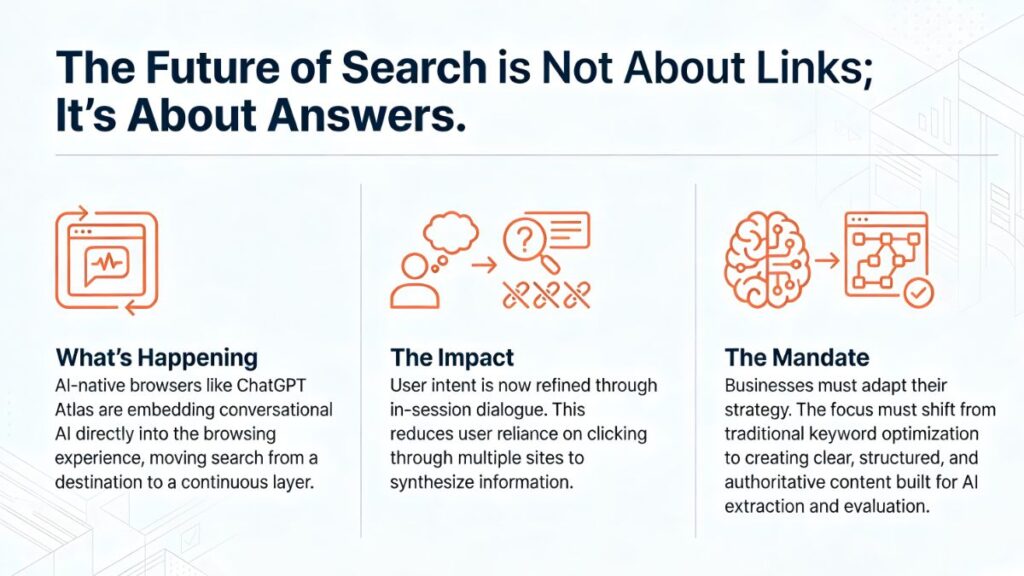
ChatGPT Atlas is OpenAI’s AI-native browser that embeds conversational AI directly into the browsing experience. Instead of sending users to lists of links, it enables AI search through summaries, comparisons, and follow-up questions inside the session itself. This shift is changing online search behavior, redefining ChatGPT vs Google search, and forcing businesses to rethink AI search optimization for the future of search with AI.
Search has traditionally been a stop-and-go activity. Users pause what they are doing, open a search engine, type a query, scan results, click a few links, then return to searching again. With the introduction of ChatGPT Atlas, that division is disappearing. Search, once a destination, is becoming a continuous, conversational layer built into the browser itself.
This change matters because it alters how users discover information, how decisions are made, and how businesses gain visibility in AI search environments.
Traditional search engines are designed around rankings and traffic distribution. Users must translate their intent into keywords and then synthesize information across multiple pages. The assumption here is that the users are willing to do the work of comparison and interpretation.
ChatGPT Atlas, developed by OpenAI, challenges that assumption. Built on a Chromium foundation, Atlas includes a persistent AI sidebar that understands the page a user is viewing. Users can ask questions about the content in front of them, request summaries, or explore related topics without opening new tabs.
AI tools, thus, have become part of the browsing experience itself.
The biggest difference in ChatGPT Atlas vs traditional Google search lies in where and how intent is refined. While Google increasingly supports conversational interaction through features like AI Overviews, its experience is still largely anchored in discrete queries and link-based navigation. Atlas, by contrast, treats intent refinement as a continuous dialogue embedded directly within the browsing session itself.
Users ask loosely, follow up naturally, and refine intent through conversational search.
This changes online search behavior in two important ways:
For businesses offering ecommerce software or complex digital products, this means evaluation increasingly happens inside AI summaries rather than across a trail of landing pages.
Atlas is not just a chatbot placed inside a browser. On paid plans, it introduces agent mode, which allows the AI to assist with multi-step tasks, such as navigating workflows or preparing actions for user approval. AI, here, is an active assistant.
Atlas includes browser memory features that allow short-term contextual recall, subject to user controls. These continuity-shaped, follow-up questions are interpreted and future responses framed. Together, the sidebar, agent mode, and memory features create a browsing experience where AI actively supports decision-making.

Content surfaced by AI search must be easy to summarize and reuse. Pages should define concepts clearly and use language that mirrors real questions.
What this includes:
Pro Tip: In conversational search, clarity often matters more than persuasion.
Users increasingly ask AI tools to compare options or assess fit. Content should anticipate these requests.
What this includes:
Pro Tip: Decision-ready content is more likely to be reused by AI tools.
When AI guides users toward action, friction becomes obvious.
What this includes:
Pro Tip: AI search optimization often exposes UX issues faster than traditional SEO.
In other words, Atlas does not remove the need for websites—it raises expectations for how clearly they explain and enable action.
As the future of search with AI unfolds, rankings and clicks alone are no longer sufficient. More meaningful signals include visibility within AI summaries, assisted conversions following AI-led evaluation, and improved completion rates for demos or sign-ups. These metrics better reflect performance in AI-mediated environments.
It is a Chromium-based browser with an integrated AI sidebar for page-aware answers, summaries, and assisted actions.
It replaces repeated keyword queries with conversational refinement inside a single browsing session.
The AI sidebar, agent mode, and memory features that shape contextual understanding.
Some discovery will shift from clicks to AI-mediated synthesis, increasing the value of clarity and authority.
Yes, by publishing structured, reference-quality content designed for AI extraction.
AI-native browsing heightens sensitivity around data retention, making transparency and user control essential.