
Enterprises are moving away from one-size-fits-all software and adopting custom app development to streamline workflows, automate processes, and achieve measurable ROI. Tailored applications built around real operations deliver higher efficiency, lower long-term costs, and stronger integration across teams. This article explores how custom app solutions shape enterprise performance in 2025.
Even in 2025, the majority of enterprises rely on a patchwork of tools such as CRMs, ERPs, spreadsheets, and SaaS platforms that are prone to miscommunication. Well, as a result, you get operational friction of the following sorts: duplicate work, inconsistent data, slow decision cycles, and workflows that bend around software instead of the other way around.
Custom app development solves this gap by creating software that aligns directly with how a business operates. Instead of adapting to rigid systems, enterprises get tools designed around their processes, teams, and growth plans.
Every enterprise has unique workflows. Ready-made tools may offer quick setup but they more often than not lack in depth, flexibility, and integration. A custom app is built from the ground up to match the exact operational requirements.
Pro Tip: If your team spends time switching between tools, or patching together processes in spreadsheets, you’re a prime candidate for custom app development.
Unlike generic tools, custom app development for enterprises embeds your internal rules, approvals, and data structures. This minimizes friction and speeds up operations.
Automated data flows replace manual entry, eliminating bottlenecks and ensuring clean, consistent information across departments.
Whether it’s a web app development project or a mobile interface, custom dashboards give leaders instant insight for faster decision-making.
By bringing sales, finance, operations, and support into the same ecosystem, information moves frictionlessly.
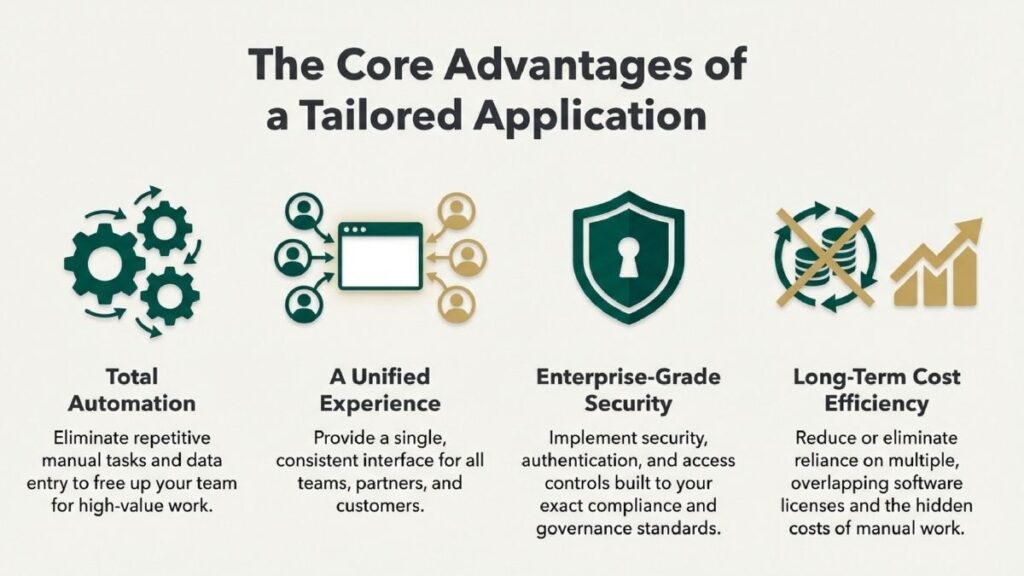
Scenario: A logistics enterprise was using separate tools for fleet management, order tracking, invoicing, and customer support.
After implementing a custom enterprise app:
Outcome: Led to a significant improvement in operational efficiency, cutting processing time by roughly 40% and achieving early, measurable ROI.
The cost of custom app development depends on factors like:
While upfront investment may be higher than SaaS tools, enterprises recover costs through:
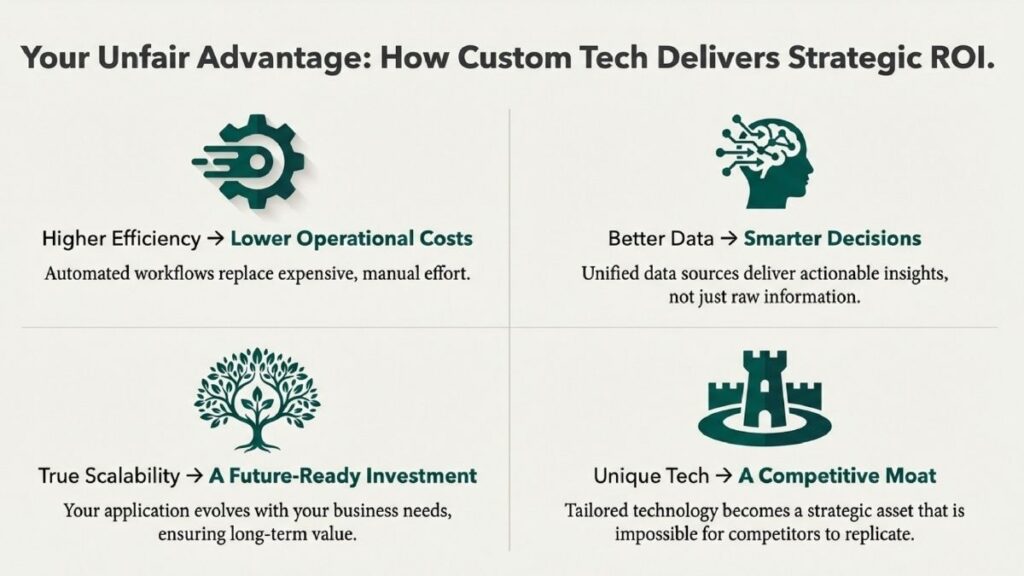
Automated workflows replace manual, repetitive effort.
Custom apps unify data sources to deliver actionable insights.
Apps evolve with business needs, ensuring long-term value.
Tailored tech becomes a strategic asset impossible for competitors to replicate.
It’s the process of building software tailored specifically to a business’s workflows, integrations, and operational needs—rather than using off-the-shelf tools.
By automating processes, reducing manual work, integrating systems, and aligning software directly with business logic.
Enterprises see ROI through faster operations, lower recurring costs, improved accuracy, better customer experiences, and scalable long-term value.
Assess expertise in enterprise architecture, integration capabilities, security standards, and ability to translate business logic into technical workflows.
Low-code platforms, microservices, AI-driven automation, cross-platform mobile app development frameworks, and cloud-native architectures.